
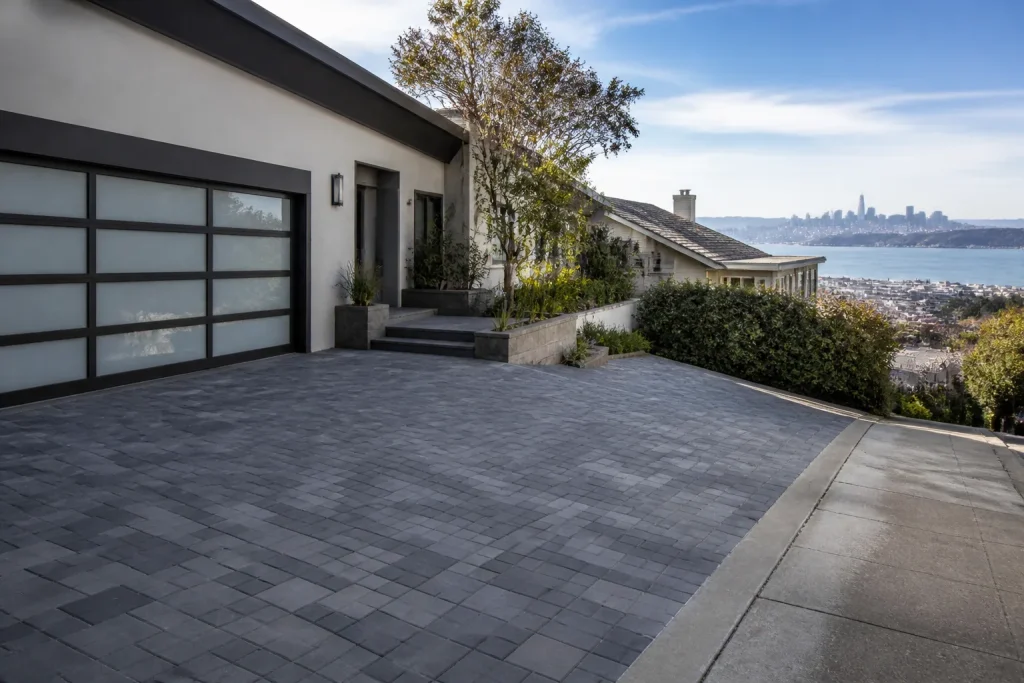
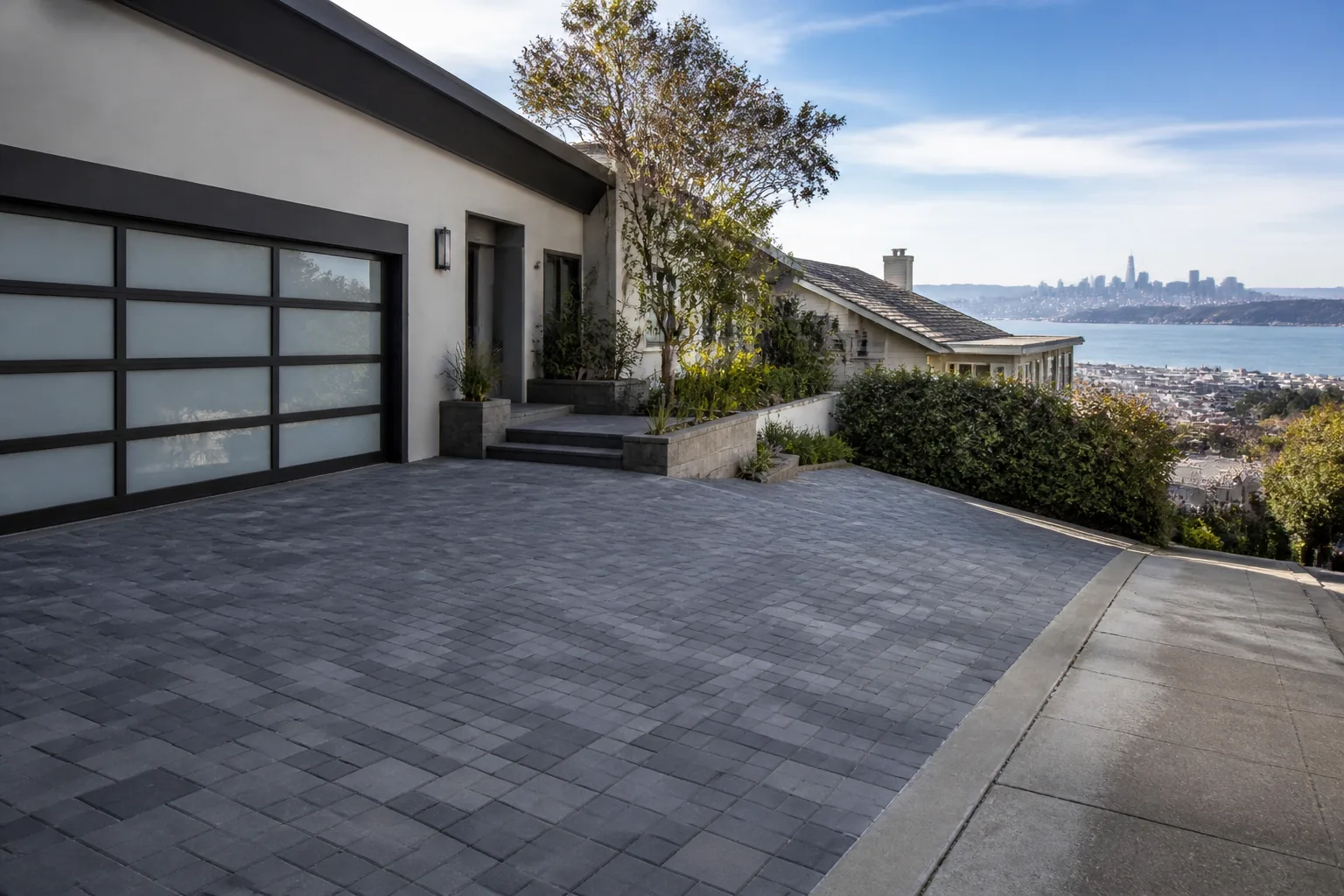
Cover Driveway & Pavers in San Francisco: A Homeowner’s Guide
A paver rated for “harsh weather” in a Phoenix catalog has never met a San Francisco winter fog cycle, and your driveway will find that out the hard way if you don’t. The short version: covering a driveway in San Francisco is less about picking a pretty paver and more about matching material, base depth, and joint sand to the specific microclimate and slope of your block. Get that wrong and you’ll be repointing joints within three years. Get it right and the surface outlasts the house.
Key Takeaways
- San Francisco isn’t one climate. Salt air in the Sunset, fog-soaked moisture in the Richmond, and steep grades in Noe Valley each demand different paver and base specs.
- Concrete pavers outperform natural stone in coastal neighborhoods because they resist salt and moisture absorption far better.
- SF has no real freeze-thaw cycle, but constant moisture is its own enemy. Drainage and joint sand matter more than frost ratings here.
- Driveway work usually needs a permit through San Francisco Public Works, and stormwater rules apply on many lots.
- Historic district and HOA overlays in places like Pacific Heights and the Castro can restrict paver style before you ever break ground.
How Does San Francisco’s Microclimate Change Paver Choice?
San Francisco doesn’t have weather so much as a patchwork of microclimates, and your driveway sits in exactly one of them. A paver that performs beautifully in Noe Valley can fail on a Sunset block two miles away. That’s the single biggest thing national paver guides miss: they treat “San Francisco” as one condition when it’s really five or six.
Here’s how the main zones break down:
- Sunset and Richmond Districts: Coastal fog and salt-laden air. Moisture hangs around, and salt accelerates surface degradation on porous materials. Concrete pavers win here.
- Noe Valley, Bernal Heights, and other hillside lots: Steep grades rule everything. Base depth and joint sand selection have to handle water sheeting down a slope, not pooling on a flat pad.
- Pacific Heights and the Castro: Historic and HOA overlays restrict style, color, and sometimes material before climate even enters the conversation.
- Inner neighborhoods (Mission, SoMa, Potrero Hill): Warmer and drier, sheltered from the fog. More material flexibility, but drainage still matters because lots are tight.
We’ve watched homeowners pick a gorgeous natural-stone paver for a Sunset driveway and regret it within two winters. The salt air and near-constant damp eat at stone joints and surfaces in a way that doesn’t happen in Sacramento or even San Jose. If you’re weighing materials, our Driveway & Pavers in San Francisco page lays out the options we install most.
Why Do Concrete Pavers Beat Natural Stone in the Sunset and Richmond?
Concrete pavers hold up better than natural stone in San Francisco’s coastal neighborhoods, full stop. The reason is moisture and salt, not temperature. Natural stone like flagstone and some travertines are porous; they absorb moisture, and in a salt-air environment that absorption accelerates spalling, staining, and joint failure. Concrete pavers are engineered with a dense, low-absorption surface and consistent dimensional tolerances that make tight, stable joints possible.
What this looks like in practice on a Richmond District driveway:
- Absorption: Concrete pavers typically absorb a fraction of what porous natural stone does, so fog moisture beads and drains instead of soaking in.
- Salt resistance: Salt air attacks surface integrity. Concrete pavers with a quality finish resist it far better than soft stone.
- Joint stability: Consistent paver dimensions mean sand stays put, which matters when moisture is a constant.
- Repairability: If one paver cracks or stains, you lift and replace it. Matching a stained natural-stone slab is a nightmare.
We pulled a failed natural-stone apron out of a garage over in the Outer Sunset last spring where the joints had essentially turned to mush. The pavers underneath were fine. Concrete pavers would have saved that homeowner a full redo. Belgard makes a solid line of concrete pavers that hold up well to coastal conditions, and it’s one of the brands we lean on for exactly this reason.
How Do Slope and Grade Dictate Base Depth in San Francisco?
On a San Francisco hillside lot, slope decides your base depth and your joint sand, and getting it wrong is how driveways wash out. A flat driveway can get away with a standard compacted base. A steep Noe Valley or Bernal Heights driveway cannot. Water moves fast down a grade, and if the base isn’t deep enough and properly compacted, it scours out from under the pavers.
What a properly built SF hillside driveway accounts for:
- Excavation depth: Steeper grades need a deeper excavated profile to fit a thicker compacted base that can handle water movement.
- Base compaction in lifts: Base goes down in compacted lifts, not one thick dump. Loose base on a slope is a washout waiting to happen.
- Joint sand selection: On grades, you want a joint sand engineered to stay in place under water flow, not a basic sand that rinses out.
- Drainage and grade-away: The finished surface must shed water away from the garage and foundation, which on a slope means deliberate planning, not eyeballing.
This is where SF differs from most of California. Freeze-thaw isn’t the driver here; constant moisture running down a grade is. A driveway built for a flat Sacramento lot dropped onto a Bernal Heights slope will fail. We’ve seen the erosion channels to prove it.
What Permits and Stormwater Rules Apply to SF Driveway Work?
Driveway and paver work in San Francisco usually requires a permit through San Francisco Public Works, and stormwater management compliance comes into play on many lots. This isn’t optional paperwork; it’s part of doing the job right, and it’s a big reason we recommend a contractor who pulls permits rather than one who suggests skipping them.
What homeowners should know before work starts:
- Public Works permitting: Driveway work that touches the public right-of-way or changes the curb cut typically needs a Public Works permit. Confirm who’s pulling it.
- Stormwater management: SF’s stormwater requirements mean runoff from hard surfaces has to be managed. Pervious or permeable paver systems and proper drainage design can satisfy this on many lots.
- Right-of-way rules: Any work in the sidewalk or street zone has its own rules and inspections.
- Inspection sign-off: Permitted work gets inspected. A contractor who pulls permits and passes inspections is a contractor worth keeping.
Ask any contractor you hire two direct questions: “Are you pulling the permit?” and “How are you handling stormwater?” If the answers are vague, walk. We pull permits and pass inspections as a matter of course, and we’ll walk you through the stormwater piece before a shovel touches dirt.
What Do Historic District and HOA Rules Mean for Paver Style?
In Pacific Heights and the Castro, historic district and HOA overlays can restrict your paver style before climate or slope ever matters. Both neighborhoods carry design review considerations, and some blocks have HOA or architectural review requirements that dictate material, color, and pattern. Picking a bold paver and finding out it’s not allowed after it’s delivered is an expensive lesson.
What to check before you choose a paver:
- Historic district status: Confirm whether your block sits in a designated historic district with design review.
- HOA architectural review: Many SF HOAs require approval of material, color, and pattern.
- Neighbor consistency: On some blocks, matching existing material keeps you out of review trouble entirely.
- Color and finish: Neutral tones and traditional patterns clear review far more easily than high-contrast or modern finishes.
The good news: quality concrete paver lines like Belgard cover a huge range of traditional colors and patterns that sail through review while still looking sharp. Historic constraints don’t have to mean an ugly driveway. They just mean choosing the right paver from the start.
Related services in San Francisco
Driveways rarely live alone. If your project also touches property lines or you’re adding a structure, see our Fence Installation in San Francisco and Home Additions & ADU in San Francisco pages, and explore everything we do from our Groundwork Construction Co. of San Francisco home page.
When Should You Call a Pro Instead of DIY?
Covering a driveway in San Francisco is not a weekend DIY job, and the slope and stormwater rules are why. The excavation, base compaction, joint sand selection, and drainage design on a hillside lot take equipment and know-how most homeowners don’t have, and the permit and stormwater pieces need someone who knows the process. A paver surface is only as good as the base under it, and a bad base on an SF grade fails fast.
Call a pro if any of these apply:
- Your lot has meaningful grade or slope
- You need a permit or stormwater compliance
- Your block has historic or HOA restrictions
- You want the surface to still look right in ten years, not two
Our technicians have up to 12 years of experience building driveways that hold up to San Francisco’s specific conditions, and every project is covered by our 730-Day Done Right Promise. Upfront pricing means the number you see is the number you pay. If you’d rather not gamble on the base work, we’re happy to take a look.
The Bottom Line
Covering a driveway in San Francisco comes down to matching material, base depth, joint sand, and permits to your exact microclimate and grade. Concrete pavers beat natural stone in the foggy, salty Sunset and Richmond. Hillside lots in Noe Valley and Bernal Heights need deeper, properly compacted base and joint sand built for water on a slope. And Pacific Heights and the Castro require clearing historic and HOA rules before you pick a style. Get those right and your driveway is a long-term asset; skip them and you’ll be redoing it in a couple of winters.
If you’re in San Francisco and need help, Groundwork Construction Co. of San Francisco offers free estimates. We pull permits, handle stormwater, and back the work with our 730-Day Done Right Promise, so call (866) 320-2646 to schedule yours. We answer calls with a live person around the clock, and the estimate and design consult are free.
Frequently Asked Questions
How much does a paver driveway cost in San Francisco? Paver driveway costs in San Francisco vary with square footage, slope, base depth, and material, with hillside lots and stormwater work running higher than flat sites. The only way to get a real number is a site-specific estimate, since your grade and microclimate drive the base requirements. Call (866) 320-2646 for a free estimate with line-item pricing.
Are concrete pavers better than natural stone in San Francisco? In coastal neighborhoods like the Sunset and Richmond, yes. Concrete pavers resist salt air and moisture absorption far better than porous natural stone, which spalls and stains faster in fog-heavy salt conditions. Natural stone can work in sheltered inland neighborhoods, but concrete pavers are the safer bet near the coast. Call (866) 320-2646 and we’ll match material to your specific block.
Do I need a permit to cover my driveway in San Francisco? Driveway work that touches the public right-of-way or changes your curb cut typically needs a permit through San Francisco Public Works, and stormwater rules apply on many lots. Confirm your contractor is pulling the permit and handling stormwater before work starts. Call (866) 320-2646 to talk through your project’s permit needs.
Will an HOA or historic district stop my paver choice in San Francisco? In areas like Pacific Heights and the Castro, historic district and HOA overlays can restrict material, color, and pattern through design review. Check your block’s status and your HOA rules before ordering pavers. Call (866) 320-2646 and we’ll help you pick a paver that clears review and performs in your climate.
Written by the team at Groundwork Construction Co. of San Francisco.
Need Construction Help?
Call Groundwork Construction Co. of San Francisco - licensed & insured, here with fast after-hours help in San Francisco.
(866) 320-2646