
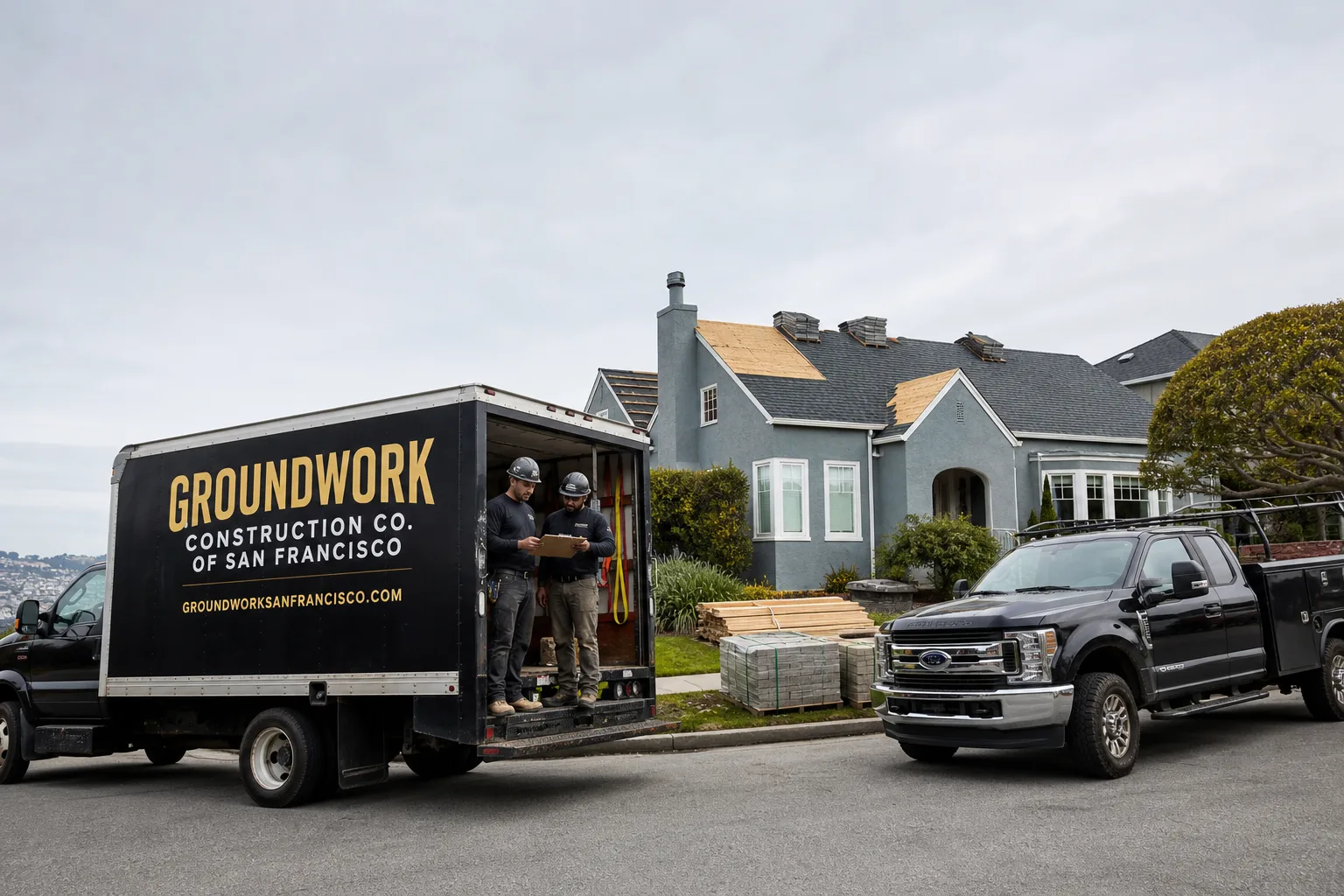
 Kitchen remodeling
 Bathroom remodeling
 Home additions & ADU
 Roofing
 Windows & doors
 Driveway & pavers
 Fence
Free written scope consultation - allowances, timeline, and change-order rules on paper before a single trade is scheduled
Styles & brands we work with
- Kitchen remodeling
- Bathroom remodeling
- Home additions & ADU
- Roofing
- Windows & doors
- Driveway & pavers
- Fence
See the difference
 Before
 After
 Before
 After
 Before
 After
Roof Leak Repair Cost in San Francisco, CA
Roof leak repair in San Francisco typically runs $470 to $2,125, with most single-area fixes landing in the $900 to $1,600 range once leak tracing is included. The city’s fog belt and dense stock of Victorians and Edwardians mean diagnosis often costs more than the patch itself. Call Groundwork Construction Co. of San Francisco at (866) 320-2646 for a free estimate. We answer live, day or night.
Why that stain on your ceiling isn’t where the water is coming in
San Francisco roof leaks lie to you. Water entering at the front parapet wall of a Sunset District flat-roof Victorian can run 12 feet along a rafter before it blooms into a brown ring on a living room ceiling. Patch that ring and you’ve fixed nothing. You’ve just redirected the next leak.
This is the single most expensive mistake we correct: homeowners paying twice because the first contractor chased the stain instead of the source. In this city, the breach is almost never where the drips appear.
San Francisco’s dominant roof type changes everything
The residential roof landscape here is flat and low-slope, mostly on Victorian and Edwardian row houses. That matters for your bill. On these roofs, the usual failure points are parapet flashing, scupper drains, and rooftop penetrations – not field membrane. Membrane failure is what homeowners worry about. It’s rarely the culprit.
That distinction drives cost. A scupper drain reseal is a tight, targeted job. Rebuilding a parapet flashing detail on a multi-unit building is slower, involves staging on a narrow lot, and often means lifting and resetting coping. Same leak, far different number. Steep-pitch hillside homes are their own story: lifted field shingles, flashing at chimneys, and wind-driven rain that finds gaps the eye can’t see.
Where you live in San Francisco shapes the price. Fog-belt roofs on the west-side hills fail differently than sun-exposed roofs downtown, and salt air from the Pacific and Bay eats standard fasteners and paint. Contractors on these hills learn to spec stainless hardware and galvanized flashing even on small jobs. Older stock – 1880s to 1920s wood-frame row houses on brick foundations – carries its own fragility. Building on and beside steep hills in one of the densest, most historic cores in the US means tight lots and careful structural work, and a leak that’s been ignored long enough can reach framing that was never designed for standing water.
What roof leak repair costs in San Francisco
Here’s the honest breakdown. Ranges below reflect what we actually see on San Francisco jobs. Your estimate is free, and the number you see is the number you pay.
| Line item | Typical range |
|---|---|
| Roof repair (general, single area) | $470 – $2,125 |
| Tile roof repair | $710 – $2,950 |
| Full roof replacement (if repairs won’t hold) | $9,440 – $23,600 |
| Metal roof installation | $17,700 – $47,200 |
When that $4,000 to $8,000 job reveals rotted sheathing, no one should have to choose between a full fix and a band-aid based on what’s in checking this week. That’s why we pair upfront pricing with 0% financing for 18 months and $1,000 off projects over $10,000. Large repairs stay financially accessible without hidden surprises.
Compare that to a flat-climate city, where diagnosing a leak is often a quick visual scan. In San Francisco, the breach can be 10 to 15 feet from the stain in balloon-frame or platform-frame homes. Finding it takes moisture meters, and sometimes infrared scanning. You pay once for the right answer. That’s cheaper than three guesses, which is why our full Roofing approach starts with tracing, not patching.
Slow leaks, marine fog, and why “it looks fine” isn’t a diagnosis
Persistent damp from marine fog means an SF roof can look intact and still let water through. Aging sealants wick capillary moisture into seams. No storm required. These slow leaks get misattributed to plumbing all the time, so a homeowner calls a plumber, replaces a valve, and the stain comes back. Mild temperatures let work proceed year-round, but moisture control and weatherproofing are a constant concern.
What to check before you call, safely and from the ground:
- Stain location and whether it grows after fog, not just rain
- Water staining on ceiling near walls, chimneys, or exterior parapets
- Bubbling or lifted paint on interior ceilings
- Daylight or rust streaks visible at flashing seams from below
Then stop. Roofs here are steep, wet, and dangerous. A trained, insured professional should handle any inspection that puts you on a ladder or a roof surface – one slip on a fog-slicked pitch is not worth the money you’d save.
Common local scenarios (and what they usually cost)
Sunset flat-roof Victorian: stain on the ceiling, actually a failed parapet flashing. Trace, reseal or rebuild the flashing detail, verify the drain. Often at the low-to-mid end of general repair.
Hillside Edwardian, steep pitch: lifted shingles after wind-driven rain. Extract, replace, and reseal field penetrations. Mid-range.
West-side fog-belt roof with recurring damp: no active storm, but water keeps showing up. Suspect capillary intrusion through old sealants. Moisture-meter tracing separates a roof leak from a plumbing one.
Row house with rotted sheathing: the repair uncovers soft decking. This is where the number climbs – and where the 730-Day Done Right Promise matters. If the same area leaks again within two years due to our workmanship, we make it right. That protection is rare in a city where misdiagnosed leaks get patched and re-patched by the next contractor.
We use verified brand partners on every roof, including GAF and CertainTeed, and our background-checked, uniformed technicians arrive prepared. Our technicians have up to 12 years of experience. See the full scope of our San Francisco service area, or start with our home page.
FAQs
Most roof leak repairs in San Francisco cost between $470 and $2,125, with single-area fixes commonly landing near $900 to $1,600 once leak tracing is included. Jobs that expose rotted sheathing run higher, up to roughly $8,000. Call (866) 320-2646 for an exact quote – estimates are free.
Yes. We answer live 24/7, so there’s no voicemail black hole, and we can often get a technician out the same day for an active leak. You’ll get upfront pricing before any work begins. Call (866) 320-2646 to schedule.
Because the breach is rarely where the stain appears. In SF’s flat-roof row houses the usual culprits are parapet flashing, scuppers, and penetrations, and water can travel 10 to 15 feet along framing before it shows. Accurate tracing needs moisture meters and sometimes infrared scanning – paying once for the right source beats patching twice.
For a localized breach with sound sheathing, repair almost always wins – general repairs run $470 to $2,125 versus a full replacement at $9,440 to $23,600. When leaks keep returning across multiple areas, replacement can be the smarter spend. Call (866) 320-2646 and we’ll tell you straight.
Get your answer, and your price, today
Don’t repaint the stain and hope. Get the actual source found, with upfront pricing and the 730-Day Done Right Promise behind the work. Call Groundwork Construction Co. of San Francisco at (866) 320-2646 for a free estimate – a live person picks up, day or night.
Written by the team at Groundwork Construction Co. of San Francisco, serving San Francisco, CA.
What Our Customers Say
"Found unpermitted work by the previous owner once he opened the wall. He stopped, explained the options and what each would cost, and let me decide rather than making it my emergency."
- Marco Castillo"He told me one part of what I wanted was a bad idea structurally and offered an alternative instead of just taking the money."
- Angela Wong"He pulled the permits himself, scheduled every sub and ran the inspections. I made one decision a week and otherwise stayed out of it, which is exactly what I was paying for."
- Robert Sullivan