
 Roofing
 Kitchen remodeling
 Bathroom remodeling
 Home additions & ADU
 Windows & doors
 Driveway & pavers
 Fence
Free written scope consultation - allowances, timeline, and change-order rules on paper before a single trade is scheduled
Specialty Roofing in Mill Valley: What It Involves and What It Costs
Specialty roofing in Mill Valley means roof assemblies that go beyond standard asphalt shingles: Class A fire-rated systems, ember-resistant details, steep-slope and hillside installs, and low-slope sections that need different membranes entirely. A typical specialty roof runs $8,000 – $20,000 for replacement work, with tile repairs at $600 – $2,500 and metal systems at $15,000 – $40,000. Most jobs take three to seven working days once materials are staged. Call (866) 320-2646 to schedule a free on-site estimate.
How We Run a Specialty Roofing Job, Stage by Stage
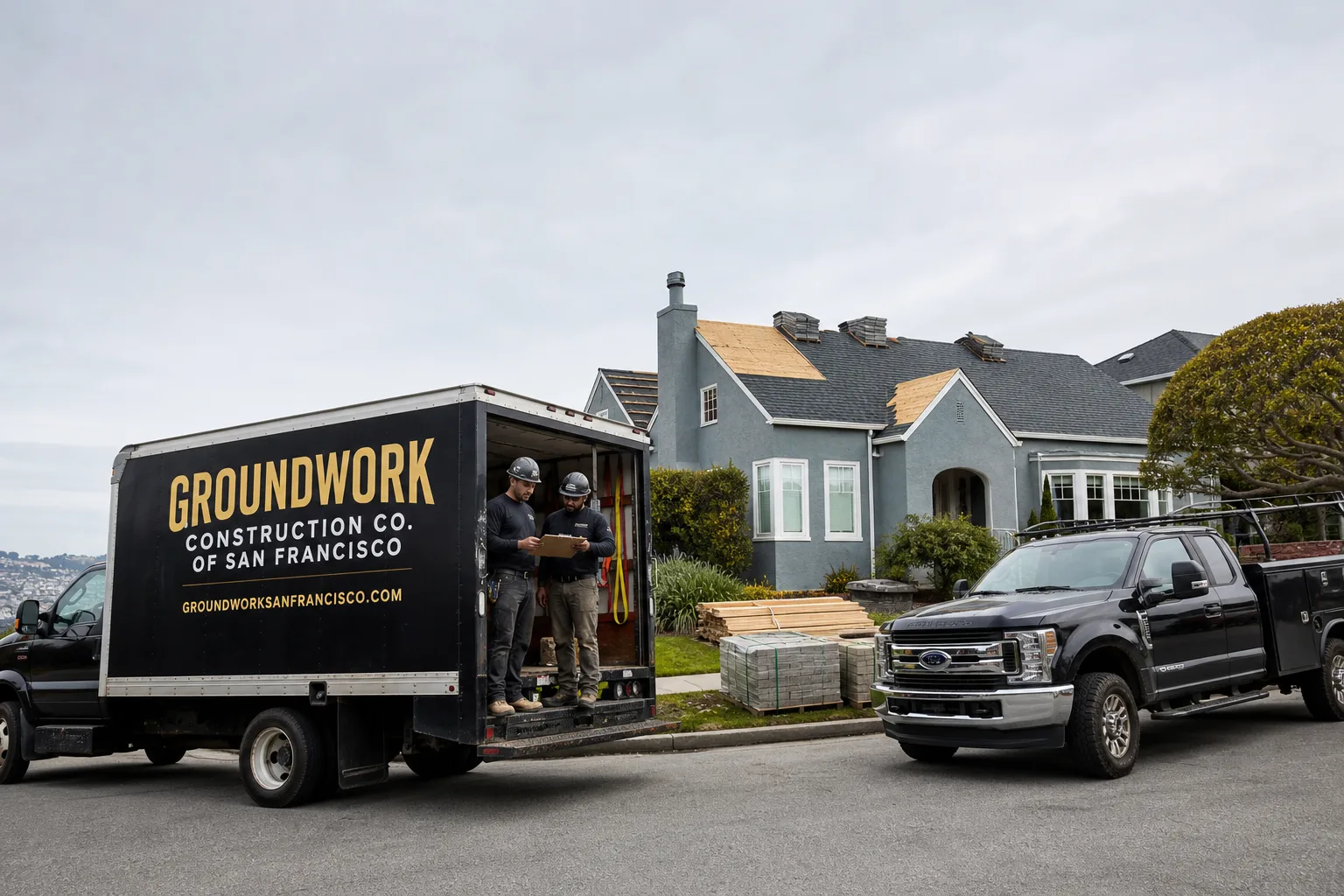
Nothing about specialty roofing in Mill Valley is turnkey. Steep lots and single-lane access change the order of operations, so here’s the real sequence we follow.
Stage 1: Site and Access Assessment (Day 1, 2 – 3 hours)
Before we quote, we walk the roof, the driveway, and the street. On hillside lanes, we need to know whether a delivery truck can turn around, where the dumpster sits, and whether we need a spotter for material drops. Pre-dawn delivery windows are common on the tighter streets. This is also where you tell us about any past unpermitted additions that touch the roof structure.
Stage 2: Teardown and Decking Inspection (Day 1 – 2)
Crews strip old roofing to the deck and inspect the sheathing. On early-1900s redwood and shingle cottages near downtown, we often find soft decking or patched-over layers that need replacement. Any rot gets flagged and photographed before we move on. You decide then whether to authorize deck repair or replace the whole section – we give you a number for each before touching it.
Stage 3: Underlayment and Fire-Resistant Detailing (Day 2 – 3)
We install a high-temp underlayment and then the details that actually matter in Marin’s wildfire exposure: ember-resistant vents, non-combustible flashing at wall and deck transitions, and Class A-rated assembly throughout. On 1950s – 70s hillside ranches, valleys and crickets often need re-framing to move water off the roof faster than the original design allowed.
Stage 4: Main Roof Installation (Day 3 – 5)
Finish materials go on – tile, metal, or a fire-rated shingle system – with ice-and-water shield at all valleys and penetrations. You’ve already picked the material at this point, so this stage is execution. Crews work in sections so the roof stays watertight overnight; we don’t leave open decking exposed to a wet winter front.
Stage 5: Final Inspection and Cleanup (Day 5 – 7)
We pull final inspection, walk the roof with you, and clear the site. Magnets run over the driveway and gutters. Any punch items get scheduled and completed under the 730-Day Done Right Promise – if it’s not done right, we make it right.
Styles & brands we work with
- Kitchen remodeling
- Bathroom remodeling
- Home additions & ADU
- Roofing
- Windows & doors
- Driveway & pavers
- Fence
The Options You’ll Choose Between
Specialty roofing is where material choice actually changes the outcome. Here’s what most Mill Valley homeowners weigh:
- Fire-rated asphalt systems (Class A): the most budget-friendly path at the low end of the $8,000 – $20,000 range. Good performance, straightforward install, and it satisfies wildfire-resistant assembly requirements. Suits 1950s – 70s ranch homes where the original roof was a basic shingle.
- Clay and concrete tile: long service life, strong fire resistance, and a look that fits the older Mill Valley housing stock. Heavier – some hillside structures need a structural review first – and tile repairs run $600 – $2,500 when individual pieces crack.
- Standing seam metal: the high-investment option at $15,000 – $40,000, with the best performance on steep slopes and the cleanest shedding of heavy winter rain. The trade-off is upfront cost and a look that doesn’t suit every cottage.
- Low-slope membrane sections: many hillside homes have a flat or low-pitch section over a deck or addition. That requires a different assembly (TPO or modified bitumen) that can’t be blended with the main roof’s material, which adds scope.
We specify GAF and Owens Corning systems where shingle is the right answer, and we walk you through the assembly ratings rather than handing you a brochure.
What Specialty Roofing Costs in Mill Valley, CA
Expect $8,000 – $20,000 for most specialty roof replacements here, $15,000 – $40,000 for standing seam metal, and $600 – $2,500 for tile repairs. Five variables push a job toward the low or high end:
- Roof size and pitch: a steep two-story hillside roof takes longer and needs more fall protection than a low ranch roof of the same square footage.
- Existing condition: patched-over layers, soft decking, or unpermitted past additions all add demolition and rebuild time.
- Material grade: moving from Class A shingle to clay tile or metal is the single biggest cost jump, often 40 – 60%.
- Access and staging: single-lane streets with no turnaround mean extra labor hours for material handling.
- Permit scope: structural or drainage changes beyond a straight re-roof widen the permit and add review time.
A written estimate from us lists line items: tear-off, decking repair, underlayment, material, labor, permit, and disposal. It does not include structural framing if we find hidden rot mid-job – we stop, photograph, and quote that separately before proceeding. Upfront pricing, no surprises.
See the difference
 Before
 After
 Before
 After
 Before
 After
What Mill Valley Homes Specifically Do to This Job
Mill Valley construction is dominated by steep hillside lots, tight tree-lined lanes, and a discretionary design-review process that makes every project a site-specific engineering and permitting puzzle. Nothing here is off-the-shelf. On many hillside streets, staging and material delivery mean navigating single-lane roads with no turnaround, and crews often need a spotter and pre-dawn delivery windows. Separately, the city’s wildfire prevention rules can require non-combustible decking and ember-resistant vents even on small remodels – and that detail carries straight onto the roof assembly.
The housing stock adds its own demands. Early-1900s redwood and shingle cottages near downtown often have original sheathing that’s seen better decades. The 1950s – 70s ranch and split-level homes on the hillsides tend to have under-sized valleys and past additions that weren’t permitted. Modern architect-designed rebuilds are usually cleaner but demand tighter waterproofing tolerances. We work in ZIP codes 94941 and 94942 and see all three types. Wet winters and long dry summers mean the roof has to handle intense seasonal rainfall and hillside runoff in the same year it resists ember intrusion – two very different requirements that the assembly has to solve at once. If the wider project scope is part of the plan, this is often folded into a full Roofing in Mill Valley package.
Serving Mill Valley, CA – Our Local Coverage Area
We serve Mill Valley and nearby communities. Use the map below to see the area we cover. If you’re nearby, we can almost certainly help.
Frequently Asked – Specialty Roofing in Mill Valley
Most specialty roofing jobs in Mill Valley take three to seven working days once materials are staged. Permitting and material lead time – especially for tile or metal – typically add two to four weeks before crews start. Call (866) 320-2646 for a timeline specific to your roof.
Yes, a re-roof and any structural or drainage change require a permit and a final inspection. The discretionary design-review process can add time on hillside lots or when the roof assembly changes. We pull permits and pass inspections as part of the job – call us to sort out what your particular address needs.
Usually, yes – a straight re-roof doesn’t touch plumbing or framing unless we find rot or a drainage problem. When a hillside roof needs re-framing at valleys or around additions, that’s a separate scope and you approve the number before we proceed. Call (866) 320-2646 to walk through your roof’s specifics.
Replacement runs $8,000 – $20,000 for most homes, metal systems $15,000 – $40,000, and tile repairs $600 – $2,500. The exact price depends on roof size, condition, material, and access. Estimates are free, and you get a written line-item quote – call (866) 320-2646.
Every specialty roofing job we complete is covered by our 730-Day Done Right Promise – if it’s not done right, we make it right. Manufacturer warranties on GAF and Owens Corning systems stack on top of that. Call (866) 320-2646 for the full written terms.
Get a Free Specialty Roofing Estimate in Mill Valley
If your roof is heading into another wet winter with patched valleys, aging shingles, or an assembly that won’t survive a wildfire season, the estimate is the right first step. Call (866) 320-2646 and a live person answers – no voicemail. We’ll set a time to walk the roof, deliver a written line-item quote, and talk through options. Most homeowners also pair specialty roofing with Energy-Efficient Windows in Mill Valley and Sliding & Patio Doors in Mill Valley when the exterior is getting attention at the same time. Our technicians have up to 12 years of experience, and every job is background-checked and uniformed. See our broader Roofing service for context, and check the Mill Valley service area page if you’re nearby.
Written by the team at Groundwork Construction Co.