
 Kitchen remodeling
 Bathroom remodeling
 Home additions & ADU
 Roofing
 Windows & doors
 Driveway & pavers
 Fence
Free written scope consultation - allowances, timeline, and change-order rules on paper before a single trade is scheduled
Roof Replacement & Installation in San Francisco: What It Involves and What It Costs
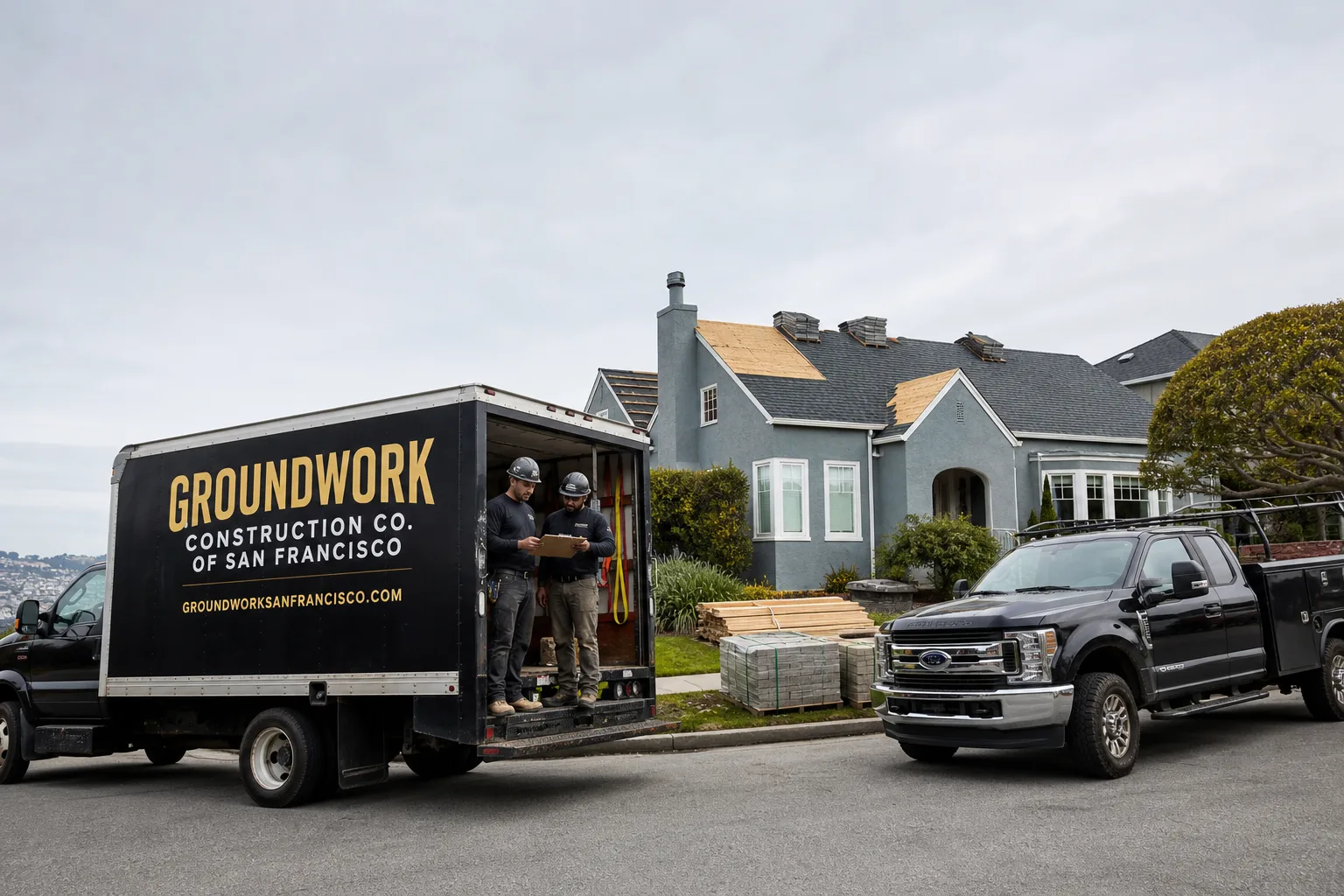
Roof Replacement & Installation in San Francisco generally runs $9,440 to $23,600, takes five to ten working days on a typical house, and starts with a tear-off down to the deck, followed by a building inspection and new underlayment before any shingle goes on. A full replacement means removing the old covering, checking and repairing the sheathing, installing new flashing at every penetration, and finishing with the membrane or shingles you choose. Call (866) 320-2646 and we’ll walk out to your roof, measure it, and put a written line-item estimate in your hands.
What the Job Actually Looks Like, Stage by Stage
Roof replacement isn’t one job, it’s a sequence of five stages, each with a point where you weigh in. Here’s how it runs when we take on a San Francisco roof.
Stage 1: Walk and measurement (day 1)
We get on the roof or inspect from a safe vantage if pitch is too steep, measure square footage, locate the vents, skylights, and chimney penetrations, and check the condition of the sheathing through any soft spots. This is where you decide the material class and get a firm written scope. Expect 45 to 90 minutes.
Stage 2: Tear-off and deck inspection (days 1 to 3)
We strip the existing covering back to the wood deck. On older San Francisco homes, that’s when we find out what the last roofer hid. Rotted sheathing gets replaced board by board, and the count goes in writing before we continue. Tear-off on a standard 1,500-square-foot roof takes one to three days.
Stage 3: Sheathing repair and underlayment (days 3 to 5)
Once the deck is sound, we fasten new underlayment across the entire field. This is the moisture barrier that does most of the quiet work on a fog-belt roof. You don’t touch it, you’ll never see it, but it’s the layer that decides whether your ceilings stay dry for the next 20 years.
Stage 4: Flashing, membrane, and field (days 5 to 8)
We install flashing at the chimney, around every vent stack, and along valleys and eaves, then run the field covering. Skylights get new seals or swap-outs. This is the longest stage and the one that gets the most attention, since flashing failures are behind nearly every call-back on a new roof.
Stage 5: Final inspection and cleanup (days 8 to 10)
We do a magnet sweep for nails, clear the gutters, and walk the job with you to confirm the scope got done. A written workmanship document goes in your file. Roofing is covered by our 730-Day Done Right Promise: if it isn’t done right, we make it right.
Styles & brands we work with
- Kitchen remodeling
- Bathroom remodeling
- Home additions & ADU
- Roofing
- Windows & doors
- Driveway & pavers
- Fence
The Options You’ll Choose Between
A roof replacement is really a set of three or four decisions made once and lived with for two decades. Here’s the honest version of each trade-off.
- Asphalt shingle (architectural grade): The workhorse of the Bay Area. Lower upfront cost, 20 to 25 year lifespan, and easy to replace a section if a branch hits it. GAF and certain architectural lines give you a wind rating strong enough for coastal exposure. If you’re staying in the house a decade, this is often the sensible choice.
- Tile and slate: Long-lived, heavy, and gorgeous on Victorian and Edwardian rooflines. But tile needs a beefier framing plan and careful flashing, and walking a tile roof for repair is its own skill. Cost climbs quickly. Worth it when the house was built for the weight and you’re keeping it.
- Standing-seam metal: The most corrosion-resistant option and the best-suited to salt air. Higher upfront cost, but a 40-plus-year service life. Our team has up to 12 years of experience installing it, and it’s what we’d spec on a west-side hill house where fog and salt eat everything else.
- Underlayment and flashing grade: The invisible choice that matters most. We spec a synthetic underlayment rated for high-wind and moisture cycling, and on the coastal edge we spec stainless or galvanized flashing and fasteners. Standard galvanized fasteners corrode in the fog belt within a fraction of the inland lifespan.
If you’re reworking the walls and openings at the same time, homeowners often pair this with Window Replacement in San Francisco, since a new roof and new windows make for one clean weathertight envelope.
What Roof Replacement & Installation Costs in San Francisco, CA
Most San Francisco roof replacements land between $9,440 and $23,600, and the spread comes down to a handful of variables, not luck.
- Roof size and pitch: A 1,200-square-foot low-slope roof is a different job than a steep Victorian gable. Every square foot above that adds both material and labor.
- Existing condition: If the last roof is two layers thick, tear-off doubles. If rotted sheathing runs further than expected, you’ll see board-by-board deck repair on the estimate.
- Material class: Asphalt sits at the low end, tile and metal climb toward the top of the range.
- Penetrations: Chimneys, skylights, multiple vent stacks, and that odd 1890s dormer all add flashing work.
- Permit scope and access: A hillside lot with no street parking for a dumpster and limited staging runs higher than a flat-lot job in the Sunset.
A written estimate from us covers tear-off, disposal, underlayment, sheathing repair allowance, flashing, the field covering, and cleanup. What it doesn’t cover in every quote from any contractor: structural repair if the framing is compromised, skylight replacements, or gutter work. Those get their own line so nothing’s hidden. We answer calls live, 24/7, and there’s no voicemail between you and a real person. From roofing to the rest of the envelope, our pricing is upfront with no surprises.
See the difference
 Before
 After
 Before
 After
 Before
 After
What San Francisco Homes Specifically Do to This Job
Every roof replacement in San Francisco is being built on top of one of the oldest housing stocks in the Bay Area, and the building itself sets the terms. Much of the city’s row-house fabric runs from 1880s-1920s Victorian and Edwardian wood-frame, with brick foundations, and those homes were not designed for modern roof loads or modern flashing standards. That’s why a tear-off here so often exposes sheathing that needs replacement and framing that needs a small retrofit before the new roof can go on.
Then there’s the marine layer. West of Twin Peaks, the fog rolls in every summer afternoon, salt air rides in from the Pacific, and it eats exposed fasteners and standard flashing faster than anywhere inland. On the hills of Noe Valley and the steep blocks of Russian Hill, contractors learn to spec stainless hardware and galvanized flashing even on small jobs, because the fog belt corrodes standard fasteners within a fraction of their normal lifespan. If you’re anywhere near the water – the Inner Richmond, the Sunset, anywhere west of the fog line – a roof spec written for Phoenix will fail early here.
And the permitting line runs through the Planning Department before it runs through the Building Department. A simple re-roof is one thing; a replacement with structural repair or a change in roof profile can trigger discretion that takes weeks before work starts. We know the difference and we plan for it. This is the same local ground our team covers across San Francisco, and we know the neighborhoods by name: the tight lots in Bernal Heights, the hillside climbs up Potrero, the historic fabric of Pacific Heights.
Serving San Francisco, CA – Our Local Coverage Area
We serve San Francisco and nearby communities. Use the map below to see the area we cover. If you’re nearby, we can almost certainly help.
Frequently Asked – Roof Replacement & Installation in San Francisco
Most San Francisco roof replacements run five to ten working days on-site, and a few weeks more if the permit pulls structural repair into the scope. Weather rarely stops us here, but Planning Department review on structural changes can. Call (866) 320-2646 for a realistic timeline on your specific roof.
Yes, a full replacement typically requires a building permit in San Francisco, and structural repair or a change to the roof profile may add a Planning Department review. We pull the permits and coordinate inspections as part of the job, so you’re not the one chasing the city.
Expect $9,440 to $23,600 for a standard replacement, with metal or tile climbing toward the top of that range. The variables are size, pitch, existing layers, material class, and access. Call (866) 320-2646 for an exact quote on your roof – the estimate is free.
Usually yes. A standard tear-and-replace stays above the deck and doesn’t move plumbing, wiring, or framing. If the deck inspection finds rot that reaches the structure, we’ll write that into the estimate before proceeding rather than surprising you mid-job.
Every roof we install is covered by our 730-Day Done Right Promise on workmanship, alongside the manufacturer warranty on the covering itself. If something’s not right, we come back. Call (866) 320-2646 to go over the coverage on your chosen materials.
Get a Free Roof Replacement & Installation Estimate in San Francisco
If your San Francisco roof is due, the next step is a free on-site estimate. We come out, measure, inspect the deck, and hand you a written line-item quote with the scope spelled out. No change-order surprises, no vague totals. Calls are answered live, 24/7. When a roof is part of a full project, it’s covered under the same Roofing in San Francisco scope, and many homeowners work it alongside Door Installation in San Francisco to close the envelope in one pass. Call (866) 320-2646.
Written by the team at Groundwork Construction Co.